
On November 2, 2026, the Foundation for Cooperation for Safety (SSVV) published the updated Safety and Health Checklist for Temporary Work Agencies (VCU 2026/6.0). The new version replaces the VCU 2011/05 and places greater emphasis on clear responsibilities, a better exchange of safety information, and effective management of the risks to which temporary workers are exposed. For Belgian temporary work agencies and their clients, the new VCU also brings important points of attention.
 A thorough update of the VCU
VCU is a certification scheme for temporary employment agencies that provide workers for risky jobs or work in a risky working environment. It is mainly used in sectors such as industry, construction, technical services and maintenance, where clients are often themselves VCA certified.
With a VCU certificate, an agency demonstrates that it has a structured safety and health management system and that it organizes the safe and healthy deployment of temporary workers in a systematic manner.
The previous version of the VCU dates back to 2011. Since then, both the regulations and the insights and practices regarding safety and health at work have evolved. A joint Belgium-Netherlands VCU working group spent years preparing. The proposals finally received the green light from the expert committees of the VCA management organizations in both countries. A final fine-tuning took place in the acceptance round with the accreditation authorities.
With VCU 2026/6.0, the certification scheme is updated and better aligned with the new VCA 2026/6.1, which was published earlier this year.
What is changing?
The renewed VCU retains the basic principles of the existing certification scheme, but strengthens and clarifies various elements.
1. Clearer responsibilities and better cooperation
An important starting point of VCU 2026/6.0 is that safe and healthy temporary work is a shared responsibility of the temporary work agency, the hiring company (in Belgium usually called the ‘user’) and the temporary worker themselves.
The new checklist places greater emphasis on clear agreements regarding the tasks to be performed, the risks involved, the required competencies, the preventive measures, and the information and instructions that temporary workers must receive.
In addition, timely information exchange is essential. After all, security preparations must begin before effective employment begins.
2. Greater focus on risk management throughout employment
Risk management must not be limited to the selection and placement of a temporary workforce. Relevant risks, changed working conditions and necessary preventive measures must also be adequately monitored during the execution of the assignment.
This requires good cooperation between the temporary employment agency and the user, including in the event of changes to the work duties, incidents or new risks in the workplace.
3. Improved traceability and documentation
The revamped VCU places greater emphasis on the demonstrable recording of information, agreements and measures taken.
Recruitment agencies must be able to demonstrate that they have obtained the required safety information, that temporary workers were properly selected and informed, and that the agreements made are actually followed through.
4. Learning more from incidents and unsafe situations
Reporting, investigating and following up on occupational accidents, near-accidents and unsafe situations will also receive more attention.
The aim is not only to record incidents, but above all to identify the underlying causes and to use the insights gained to improve the safety of future assignments.
5. Better alignment with VCA 2026/6.1
The new VCU is better aligned with the updated VCA checklist for contractors. This should strengthen the coherence between the safety management systems of temporary work agencies and their VCA-certified customers.
Especially in the areas of responsibilities, risk management and information exchange, that coordination is important.
Belgian work file remains central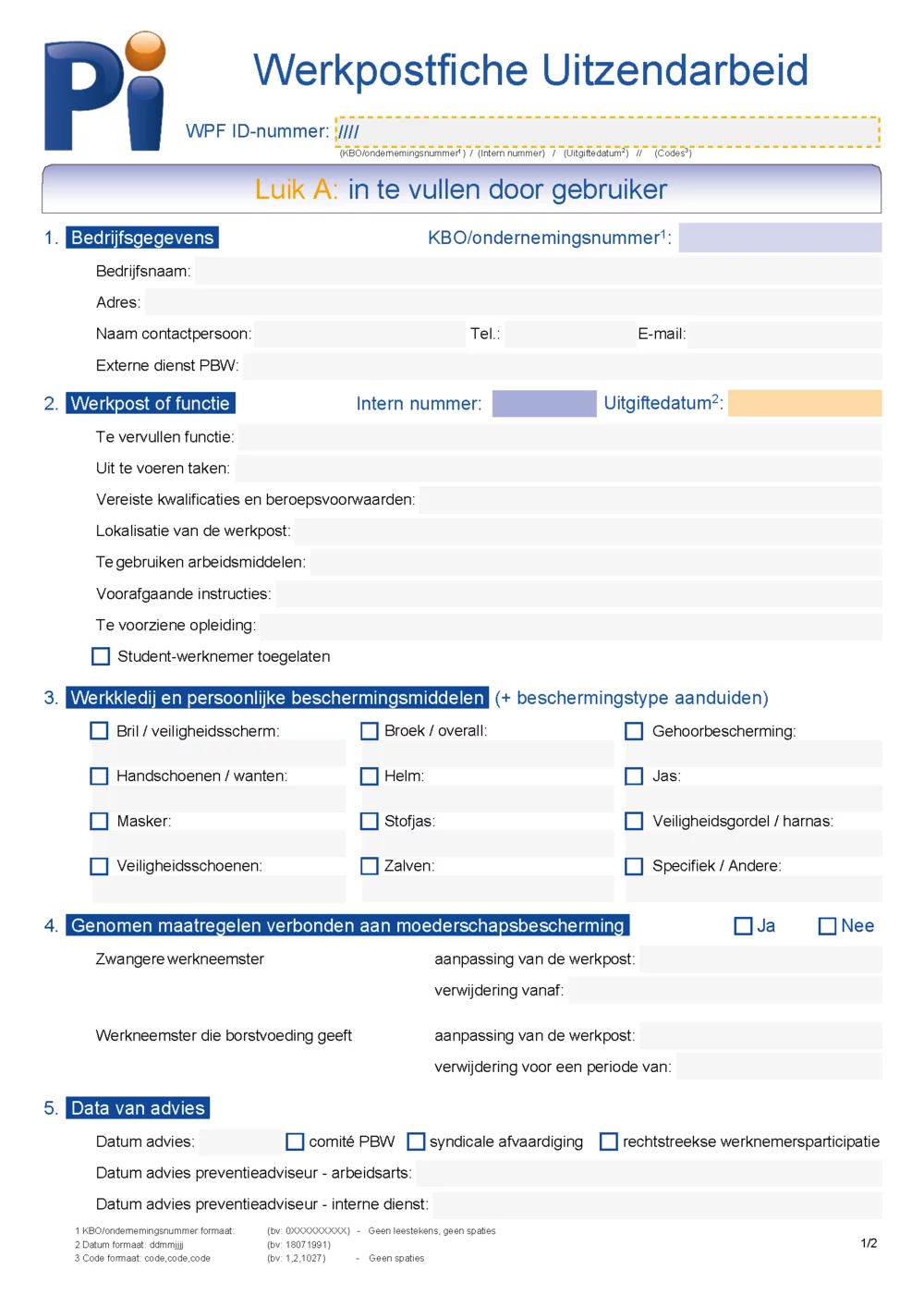
A notable innovation is the introduction of the Risk Scan Recruitment Agency (RSU) in the Netherlands. This instrument supports the exchange and recording of information about the activities, the risks, the management measures and the responsibilities of the parties involved.
However, a different arrangement applies to Belgium. Here, the statutory work record sheet remains the appropriate instrument. The RSU is therefore explicitly intended for the Netherlands; in Belgium, the work station fiche remains applicable.
Within the Belgian welfare regulations, the work station fiche plays an important role in the exchange of information between the user and the temporary employment agency. It contains, among other things, information about the work station, the required qualifications, the risks and the applicable measures regarding health surveillance and personal protective equipment.
The new VCU does not change the legal obligations that apply in Belgium regarding the employment of temporary workers. The certification scheme forms an additional, voluntary guarantee of a structured approach to safety and health.
For Belgian temporary employment agencies, the challenge therefore lies primarily in optimizing the use of the existing job profile and the associated information exchange, and in demonstrably following through on the agreements made throughout the entire employment period.
What does this mean for Belgian temporary employment agencies and users?
The new VCU requires certified temporary work agencies to review their existing safety and health management system against the updated requirements.
Among other things, the selection and qualification of temporary workers, the exchange of information with users, the instructions given to temporary workers, the monitoring of working conditions, and the recording and analysis of incidents all deserve special attention.
Active participation is also essential for the users of temporary workers. They usually possess the most concrete knowledge of the work position, the tasks involved and the risks present. Timely, complete and correct information transfer to the temporary work agency is therefore essential. This also applies to any incidents or accidents that may occur to temporary workers.
The VCU certificate does not exempt the user from his legal responsibilities regarding safety and health at the workplace.
Transition to the new VCU
The new VCU 2026/6.0 comes into effect January 1st, 2028 in effect.
Until that date, temporary employment agencies can prepare themselves to adapt their procedures, documents, registrations and working methods to the new requirements. Starting January 1, 2028, certified temporary employment agencies must operate in accordance with the new VCU and the transition assessments can take place.
According to the official transition arrangement, starting April 1, 2029 only certificates according to VCU 2026/6.0 are valid. The transition period therefore offers existing certificate holders the opportunity to implement the new requirements in stages and to have the necessary certification assessment carried out in a timely manner.
More than an administrative adjustment
With VCU 2026/6.0, it is once again emphasized that safe and healthy temporary employment is not solely the responsibility of the temporary employment agency or the company where the temporary worker is employed.
Effective prevention requires cooperation, a clear division of responsibilities and a good exchange of information, both before and during employment.
For Belgian temporary employment agencies, the new VCU offers an opportunity to critically evaluate their existing processes, strengthen collaboration with users, and better integrate the legal employment file into a coherent safety and health policy.
Official documents: click here.

 EN
 NL
 FR